Submission


|
EDITORIAL POLICIES IAIC Transactions on Sustainable Digital Innovation (ITSDI) Publication governance, peer review, research integrity and open access for sustainable digital innovation. |
|
RESEARCH FOCUS Sustainable digital innovation for meaningful advances in society, business, technology and the environment. |
IAIC Transactions on Sustainable Digital Innovation (ITSDI) disseminates scholarly research on sustainable innovation, including its relevance to business research and contemporary technological challenges. The journal invites manuscripts in the following eight (8) research areas, consistent with its official Focus and Scope.
| 01 |
Artificial Intelligence for Good AI applications that address social and environmental challenges for broader public benefit. |
| 02 |
Green Information Systems Information systems designed to support sustainable activities and reduce environmental footprints. |
| 03 |
Smart Control Systems IoT and smart-sensor control technologies that improve industrial efficiency and environmental performance. |
| 04 |
Eco-friendly Computer Engineering Hardware innovations that reduce energy use and e-waste through sustainable design and materials. |
| 05 |
Circular Digital Economy Digital technologies supporting circular economic models, efficient resource use, and waste reduction. |
| 06 |
Cyber Security for Resilient Infrastructure Security strategies protecting critical infrastructure and improving resilience against cyber threats. |
| 07 |
Data Science for Social Impact Data analysis that addresses societal problems and enhances community well-being. |
| 08 |
Multidisciplinary Innovations for Sustainability Interdisciplinary solutions integrating different fields to meet sustainability challenges. |
|
Research Audience ITSDI welcomes academics, graduate students, professionals and others interested in business research and sustainable innovation. |
Editorial Considerations Different research methodologies are welcome when scholarly standards are met. Decisions consider contribution, analytical rigor, presentation quality and independent review. |
Read the journal's official Focus and Scope for the current policy.
Articles are submitted through the journal’s online submission system. Editorial screening, indexing metadata and peer review are applied according to the manuscript category and the journal requirements.
| Section | Open Submissions | Indexed | Peer Reviewed |
| Articles | ✓ | ✓ | ✓ |
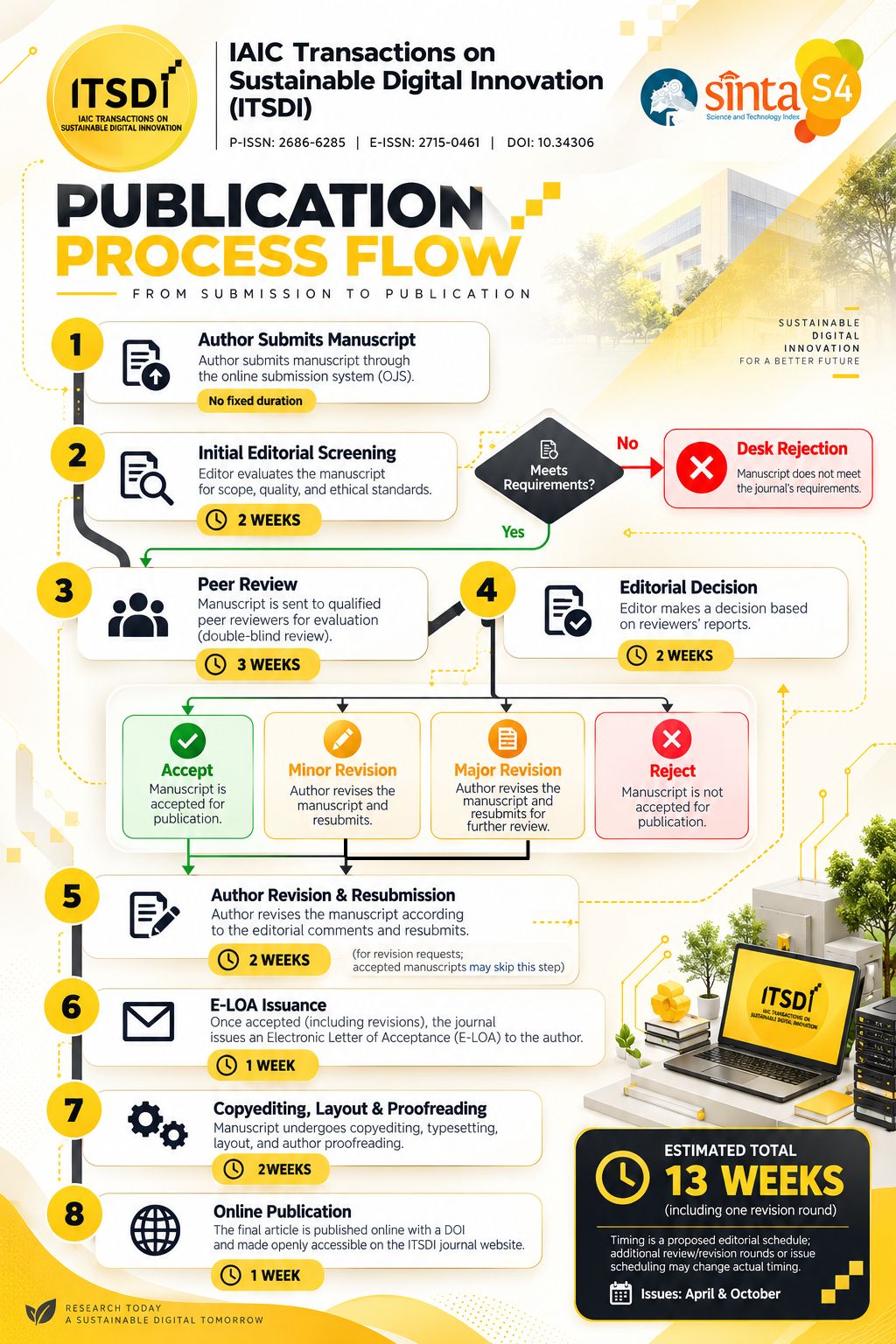
IAIC Transactions on Sustainable Digital Innovation (ITSDI) publishes manuscripts that meet the journal's author guidelines, template, and focus and scope. Before external review, each submission is checked by the editorial team for suitability, originality, and ethical compliance. All eligible manuscripts undergo a double-blind peer-review process.
The Editor-in-Chief assigns a handling editor to coordinate manuscript evaluation and communicate editorial decisions through the journal's submission system.
| 1 |
Initial Submission and Desk Screening Action: Authors submit their manuscripts through OJS. The editor checks the journal scope, formatting, completeness, and similarity report. Possible Outcomes: The manuscript proceeds to peer review or receives a desk rejection if it does not meet the requirements. |
| 2 |
Double-Blind Peer Review Action: Eligible manuscripts are evaluated by at least two independent reviewers, without disclosing the identities of authors or reviewers to one another. Evaluation Criteria: Originality, scientific contribution, methodology, relevance, and clarity. Output: Reviewer reports and recommendations, normally submitted within 14 working days under the stated workflow. |
| 3 |
Editorial Decision and Revision Action: The editor considers the reviewers' reports and issues a decision: accept, minor revision, major revision, or reject. Revision: Where revisions are requested, authors submit the revised manuscript and a response to reviewer comments within 7 days. The editor may arrange further evaluation if necessary. |
| 4 |
Acceptance and Final Publication Action: After final acceptance, an electronic Letter of Acceptance (E-LOA) is issued. The manuscript undergoes copyediting, layout, proofreading, and DOI registration before publication on the ITSDI website. |
|
Final Editorial Authority. The Editor-in-Chief makes the final publication decision based on the reviewers' recommendations, the manuscript's scientific merit, and ITSDI's ethical and editorial standards. |
ITSDI is published twice annually, in April and October. Manuscripts may be submitted throughout the year. Accepted articles are scheduled for an appropriate forthcoming issue according to the editorial and production process.
| April First scheduled issue |
October Second scheduled issue |
10 articles Stated target per issue |
IAIC Transactions on Sustainable Digital Innovation (ITSDI) is a fully Open Access journal. In accordance with the principles of the Budapest Open Access Initiative (BOAI), all published articles, reviews, and editorial materials are made freely, permanently, and immediately available online worldwide upon publication without subscription fees, paywalls, or registration barriers.
|
You Are Free To Share — copy and redistribute the material in any medium or format for any purpose, even commercially. |
Under the Following Terms Attribution — You must give appropriate credit, provide a link to the license, and indicate if changes were made. You may do so in any reasonable manner, but not in any way that suggests the licensor endorses you or your use.
|
ITSDI describes a long-term preservation and repository policy to support continued access to its scholarly record. The following services and mechanisms are named in the journal’s existing archiving statement.
| Preservation mechanism | Description |
| PKP Preservation Network (PKP PN) | The journal states that it uses the Public Knowledge Project preservation network for digital content preservation. |
| LOCKSS, CLOCKSS | Distributed preservation mechanisms for storing and maintaining copies of scholarly content over time. |
|
Preservation Transparency The editorial office should periodically verify the actual activation and preservation status of each named service. A publisher manifest or a mention of a service does not by itself confirm completed deposit or participation.
|
ITSDI sets out ethical responsibilities for editors, reviewers, authors and the publishing organization. Its publication ethics statement draws on the COPE Core Practices, with an emphasis on integrity, fairness, confidentiality, transparency and the responsible handling of scholarly work.
|
7.1 Publisher and Editorial Governance Independence. Financial or commercial considerations must not influence editorial decisions.
Accountability. The publisher and editorial board support fair procedures for handling concerns about published content. |
|
7.2 Duties of Editors Publication decisions. Manuscripts are assessed for validity, originality, contribution and relevance.
Non-discrimination. Editorial assessment is based on scholarly merit. Confidentiality. Submission materials are shared only with authorized participants in the editorial process. Conflicts of interest. Editors recuse themselves when their independence may be compromised. |
|
7.3 Duties of Reviewers Objectivity. Reviews should be evidence-based, constructive and respectful.
Promptness. Reviewers unable to meet the agreed deadline should inform the editor. Confidentiality. Unpublished work is not disclosed or used for personal advantage. Sources and conflicts. Reviewers identify relevant uncited research and disclose competing interests. |
|
7.4 Duties of Authors Accurate reporting. Methods, findings and data should be presented truthfully and with sufficient detail.
Originality. All third-party work must be acknowledged; plagiarism and concurrent submissions are unacceptable. Authorship. Only substantial contributors should be named as authors and all authors should approve submission. Funding and interests. Relevant support and conflicts must be disclosed. Errors. Authors must notify the journal of serious errors discovered after publication. |
|
7.5 Corrections and Retractions When substantial errors or research-integrity concerns are identified, the journal may publish corrections, expressions of concern or retractions as appropriate, following COPE guidance and a documented investigation. |
7.6 Complaints and Appeals Authors and readers may raise substantiated concerns with the journal editorial office using the official contact channels. Appeals should be considered by an editor without a conflict in the original decision. |
ITSDI publishes its author publication fee through the official Article Processing Charge (APC) page. The payment is requested after acceptance and before publication. Editorial acceptance is based on scholarly merit and is independent of payment.
| USD 100 APC per accepted article |
| Item | Published fee information |
| Article Processing Charge | USD 100 per accepted article |
| Payment timing | After acceptance and before publication, following the official invoice and journal instructions |
| Publication services | Supports editorial administration, peer-review coordination, copyediting, digital publication, DOI registration and dissemination |
| Submission fee | No separate amount is stated in the cited APC schedule; authors should consult the editorial office if clarification is needed |
|
Reader Access The APC is a charge to authors of accepted articles, not a reader-access charge. ITSDI readers can access published open-access articles without payment.
|
ITSDI records articles using Digital Object Identifiers (DOIs) through Crossref under the prefix 10.34306. The journal lists the following indexing, discovery and bibliographic services. Listings should be reviewed periodically for accurate journal metadata.
|
Journal Identification E-ISSN: 2715-0461 | P-ISSN: 2686-6285 | DOI prefix: 10.34306
|
A bibliographic listing, ISSN registration or DOI registration should not be described as an accreditation or membership of an indexing database unless that status has been verified independently.
Manuscripts are screened for textual similarity using tools identified by Turnitin. The published policy sets a maximum similarity level of 20%. Editors assess the report in context, taking into account properly quoted text, references, overlap and the nature of the matched material.
| Similarity level | Editorial action |
| 20% or below | Eligible for editorial consideration, subject to assessment of the similarity report and research integrity. |
| Above 20% | Returned for necessary revision or rejected according to the amount and nature of unattributed or inappropriate overlap. |
Manipulated citations, misappropriation of ideas and other forms of plagiarism remain unacceptable even when an overall similarity score is low.
|
|
IAIC Transactions on Sustainable Digital Innovation
E-ISSN : 2715-0461 , P-ISSN : 2686-6285 Supported by APTIKOM & Organized by IAIC Bangun Bangsa (IBB) Website : https://aptikom-journal.id/index.php/itsdi/index Published by Pandawan Sejahtera Indonesia Email : [email protected]
|